exterior house painting airless sprayer
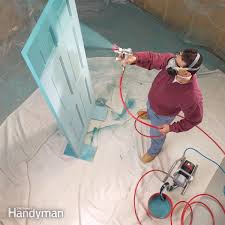
An airless sprayer simplifies painting in two ways: First, if you want to speed up a job that requires several gallons of paint, you can apply it twice as fast as with a roller or brush. And second, if you want a glass-smooth finish on woodwork or doors, the airless sprayer can lay the An airless sprayer works by pumping paint at a very high pressure, up to 3,000 psi, through a hose and out a tiny hole in the spray gun tip. tip is designed to break up the paint evenly into a fan-shaped spray pattern of tinyUsing different tips, you can spray thin liquids like stain, lacquer and varnish or thicker liquids like latex house paint. With a little practice, you can use an airless sprayer to apply a perfectly smooth finish on doors, cabinets and woodwork. since an airless sprayer pumps paint directly from a can or 5-gallon bucket, you can apply a lot of material in a short time. makes an airless sprayer particularly well

suited for large paint jobs, like priming bare drywall in a new house or painting a But before you get too excited about the benefits of spray painting, there are a fewFirst, the fine particles of paint don’t all stick to the surface. A large percentage of the paint ends up in the air, where it can drift and settle ontoThis means you’ll be wasting 20 to 40 percent of the finish, depending on the application. have to take extra time to mask off and cover up everything you want to keepOutdoor painting is especiallyOverspray can end up on your shrubs or roof, or drift with the wind onto The other downside is the extra time it takes to flush the paint from the pump and hose and clean up the spray gun. using your own sprayer, rather than a rental unit, you’ll also have to clean the filters and install special storage fluid. you’re spraying oil-based products, you’ll have to store or recycle a gallon or two of

Usually the gun, line, and one tip are included when you buy a sprayer. Mist mask or respirator Note: In addition to the sprayer, it’s likely you will want to have on hand some or all of the same equipment required when painting the house with a brush and roller, listed again below with a few modifications.
average price per square foot paint interior houseHowever, the need for rollers (and “backrolling”) will depend on the type of siding you are painting—see instructions):
christmas decoration in miami (all reasonably clean, and two should be very clean—these will be used to spray out of) (having two is helpful, especially if you’re painting multiple colors)Thicknesses will range from , , , , and , depending on how rough the surfaces are.

It’s best to err on the side of thicker rather than thinner naps. 1/2-inch or 3/4-inch will handle most situations. that fit into 5-gallon buckets (two, for attaching paint buckets to ladders) Ladders (house dependent, but a and and (optional, handy for doing large areas of siding, but hard for one person to put up and take down) High quality exterior latex paint (low lustre). Measure square footage and divide by 275 to determine how many gallons are needed. Easy access to lots of clean water Take comfort in the fact that the dirty work is behind you: the pressure washing, the scraping, the sanding. Now comes the payoff as you apply a smooth, protective coat of high quality latex paint to the house’s dehydrated and grateful exterior. It’s a satisfying feeling when you paint a house right. Know this: The most time-consuming aspect of actually painting the house is the transference of paint from the can to the house—in other words, the amount of time the paint spends making that trip.

Obviously using a helps greatly to reduce that time because it offers a direct, high speed line from the bucket to the siding. However, spraying requires you to spend more time . The amount of time that takes greatly depends on the house. Sometimes spraying is a lot faster than brushing and rolling; sometimes it takes the same amount of time but is still worth it because it’s a little easier on your body; and sometimes spraying just isn’t worth it due to an excess of “stuff” on and near the house, including foliage and nearby neighbors, that would need to be protected from overspray. All that said, spraying a house is entirely possible for your average person. You just need to follow the steps and procedures I demonstrate in my videos, including and . First, forget about those cheap plastic paint sprayers you see advertised in commercials or sold at K-Mart. The only possible use a person might have for one of those is to spray a popcorn ceiling inside. They actually work pretty well for that.

But for anything else, forget it. They have no power and no capacity to hold paint. You pour one gallon at a time into the pot—do you know how fast you fly through a gallon of paint when you’re using a professional-grade airless paint sprayer? You’ll spend half your time refilling that stupid pot. So you either need to borrow or rent a real , the whole outfit including the spray gun. You’ll need a beefy 12-gauge extension cord. You’ll also need a tip for the gun. I use a “515” or “517” tip for spraying regular latex paint, but this gets too jargony. Ask at the paint store what size tip you should use for the material (paint/stain) you are spraying. Before you actually spray, you need to “mask off” the house with painters’ plastic and paper as described in Step 6: Masking (Taping) the House and Arranging Drop Cloths. Because you are spraying you need to seal everything up really tight—much more so than if you were brushing and rolling. Don’t underestimate the power of the sprayer to blast through a shaky masking job and dust a fancy front door or expensive outdoor light fixture with overspray.

You should also see , where I demonstrate the specific technique used to quickly put tape and plastic over windows, doors, and other things you don’t want to get overspray on. Once the house is masked good and tight and the are arranged, it’s time to start praying. It will go just fine if you adhere to the First Commandment of Spraying: Never stop moving the gun when the trigger is pulled and paint is blasting out. Keep that gun ever in motion like a shark in the ocean, because the instant you stop, a pile of glop will appear on the side of the house and bam, you’re screwed. It happens that fast. It’s not a big issue if you are “backrolling” all the paint into natural wood or stucco, but if you’re spraying smooth lapboard siding, or cement-composite siding like Hardiplank, and the goal is to just spray it on and let it dry without backrolling, then having to feather out heavy spots with a brush or roller can cause the paint to “flash.” Dark colors are especially prone to this.

(It is possible to touch up such flashing in a manner that it won’t show—see the put up, touch up, and clean up video for tips.) Here’s how to make sure you never stray from the First Commandment. First, start your arm in motion before pulling the trigger. Call this your lead-in. Second, continue moving your arm after you release the trigger, if only for an instant—this is your follow-through. If you lead-in and follow-through every time, you’ll be way ahead of the pack as a sprayer. Beyond that universal rule, basic spraying requires only a few simple techniques. First, use broad, sweeping strokes with your arms, either side-to-side or up-and-down, depending on the orientation of the siding—go the same direction as it does. When you reach the end of a stroke, don’t just start back the other way—that micro-second of being on the same spot, the turnaround point, will cause a build-up of paint, and even if it doesn’t outright run down the siding, it will be visible later as a flash.
So instead, flick your wrist away from the surface while you switch directions, directing the spray off into space for just an instant, then bringing it back down onto the siding like a plane coming in for a landing. Continue down the runway to the next turnaround spot, do the wrist-flick, and then come back. Be aware of where the wrist-flicked paint is drifting because you might speckle something, like your neighbor’s house or car. Be especially vigilant if you live in a tight neighborhood. After you’ve sprayed the area of siding in front of you, move the ladder horizontally and spray the next section. Overlap your spray strokes by about fifty percent to avoid light spots and keep a wet edge all the way across the side of the house just as described in the video on painting the house with a brush and roller. Spray on a good, heavy coat, because it could be said that the number one cause of poor paint jobs is not using enough paint. While basic spraying is not overly difficult, there is a lot more to know about spraying, and nobody knows it all.