christmas decorations on public property

It’s become a holiday tradition. Each year, in the weeks leading up to Christmas, countless towns and localities around the United States allow a Christmas nativity scene or crèche to be put on government property, often in front of a town hall or a courthouse. And each year, in at least a few of these places, people object to these displays – sometimes through legal action, arguing that the displays violate the Establishment Clause of the Constitution’s First Amendment. Already this year, controversies over the placement of nativity scenes have arisen in places like Portsmouth, Virginia; and Cherokee County, Texas. So far, officials in these and other places have not been forced to remove their crèches. A new Pew Research Center survey finds that most Americans favor allowing religious displays like nativity scenes to be placed on government property. The survey found that 44% of U.S. adults say that Christian symbols should be allowed even if they are not accompanied by symbols from other faiths, such as Hanukkah menorahs, while another 28% say Christian symbols should be permitted as long as they are accompanied by symbols of other religions.

The Supreme Court has addressed the constitutionality of nativity scenes on public property on more than one occasion. In one case, Lynch v. Donnelly (1984), the court ruled that a nativity scene in a shopping district in Pawtucket, Rhode Island, did not promote or endorse Christianity and thus did not violate the Establishment Clause because the display also contained secular symbols of Christmas, such as a Santa Claus and reindeer. The Lynch decision spawned what has become known as the “reindeer rule,” an assumption that a religious nativity scene can survive a court challenge as long as it is part of larger holiday display that contains secular holiday symbols or symbols from other religious traditions. This perspective was bolstered by a second Supreme Court decision, County of Allegheny v. ACLU (1989). In that case, a fractured court ruled unconstitutional a nativity scene inside the Allegheny County Courthouse in Pittsburgh, which was unaccompanied by any other symbols or displays.
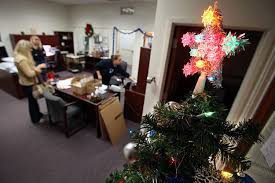
In the same ruling, the court permitted a different religious display (a Hanukkah menorah) outside a government building because it also included more secular symbols, such as a Christmas tree and a sign reading “salute to liberty.” Since then, the Supreme Court has not addressed the issue. But lower courts have considered the details of many cases, and have come to different decisions based on many factors, including the precise location and content of a display and the religious diversity of a community. Recently, perhaps in response to legal precedent, some public spaces have been opened during the holidays to nontraditional groups, making for strange bedfellows. This year, for instance, the rotunda of the Florida state capitol is expected to house a number of displays, including two nativity scenes and a diorama depicting an angel being cast into hell. The diorama is sponsored by the Satanic Temple, which threatened to sue the state after Florida officials rejected the group’s proposed display last year as “grossly offensive.”

This year, it was approved, along with a Festivus pole (from a made-up holiday on “Seinfeld”) and a display dedicated to the Flying Spaghetti Monster. Topics: Christians and Christianity, Religion and Government Lynch v. Donnelly, 465 U.S. 668 (1984), was a United States Supreme Court case challenging the legality of Christmas decorations on town property. Pawtucket, Rhode Island's annual Christmas display in the city's shopping district, consisting of a Santa Claus house, a Christmas tree, a banner reading "Season's Greetings," and a crèche, was challenged in court.
christmas tree farm for sale bcThe crèche had been a part of the display since at least 1943.
wedding rental fort worth tx[1] The plaintiffs brought the suit to the District Court of Rhode Island, which permanently enjoined the city from displaying the Nativity scene as a violation of the Establishment Clause of the First Amendment to the United States Constitution.
home decor stores in berkeley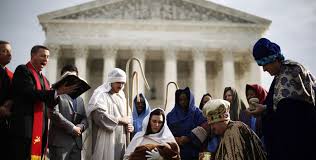
The Court of Appeals for the First Circuit affirmed the district court's ruling. The city then petitioned to the U.S. Supreme Court, which granted certiorari. The Supreme Court reversed previous rulings in a vote of 5–4, ruling that the display was not an effort to advocate a particular religious message and had "legitimate secular purposes." Chief Justice Burger delivered the opinion of the Court, in which Justices White, Powell, Rehnquist, and O'Connor joined.[2] The Court held that the crèche did not violate the Establishment Clause based on the test created in Lemon v. Kurtzman (1971). They ruled that the crèche is a passive representation of religion and that there was "insufficient evidence to establish that the inclusion of the crèche is a purposeful or surreptitious effort to express some kind of subtle governmental advocacy of a particular religious" view. They also stated that the Constitution "affirmatively mandates accommodation, not merely tolerance of all religions, and forbids hostility toward any."

The Court ruled that the crèche has a legitimate secular purpose within a larger holiday display to celebrate the season and the origins of Christmas which has long been a part of Western culture. The Federal "Government has long recognized—indeed it has subsidized—holidays with religious significance." For example, the first Congress that passed the First Amendment enacted legislation providing for paid Chaplains in the House and Senate, and "It has long been the practice that federal employees are released from duties on Thanksgiving and Christmas while being paid." The court compared the crèche to the display of religious paintings in government funded museums. In addition, the crèche requires only minimal expenses for assembly and dismantling. The Court also stated, "no inquiry into potential political divisiveness is even called for" because the situation does not involve direct aid to church-sponsored organizations and because the crèche been displayed for 40 years with no problems.
Justice O’Connor, in her concurring opinion, offered a "clarification" of how the Establishment Clause should be read: The Establishment Clause prohibits government from making adherence to a religion relevant in any way to a person's standing in the political community. Government can run afoul of that prohibition in two principal ways. One is excessive entanglement with religious institutions ...The second and more direct infringement is government endorsement or disapproval of religion. Endorsement sends a message to nonadherents that they are outsiders, not full members of the political community, and an accompanying message to adherents that they are insiders, favored members of the political community. This is sometimes referred to as the "Endorsement Test." A law which fails this test is found to be unconstitutional because it "endorses" religion or religious beliefs in such a way that it tells those who agree that they are favored insiders and those who disagree that they are disfavored outsiders.

The other side of the coin would be the "disapproval" of religion or religious beliefs in such a way that those who agree with the beliefs are told that they are disfavored outsiders while those who disagree with the beliefs are told that they are favored insiders. Justices Brennan, Marshall, Blackmun, and Stevens dissented. The dissenting opinion argued that the case did not pass the Lemon test.[4] The secular display surrounding their secular purpose of celebrating of a national holiday could have been done without a clearly religious symbol that supports only one religion to the exclusion of others giving one group public approval of their views. Even if other religious groups are allowed to include "'competing efforts [by religious groups] to gain or maintain the support of government' may 'occasio[n] considerable civil strife.'" The religious crèche is also placed in a central location within the display, which makes even less of the Court's idea that Pawtucket was just including all of the traditional images.